
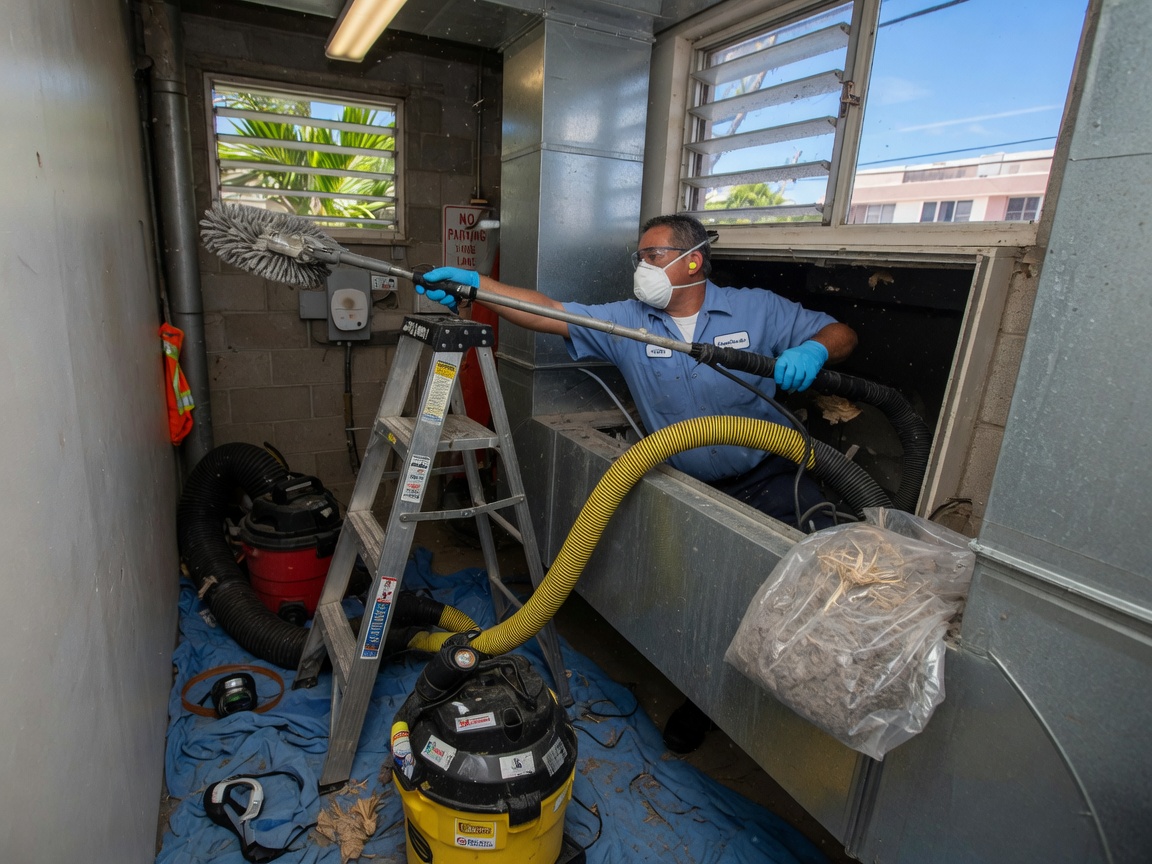
Honolulu's tropical climate keeps relative humidity high year-round, so dust, pollen and mold spores collect quickly inside supply and return ducts. Homes built before 1980 in Nuuanu, Manoa and Kaimuki often have unsealed metal ducts with fiberglass liners that trap moisture and support microbial growth. Trade winds carry fine red dirt and salt aerosols that accelerate corrosion on registers and flexible connections, especially in single-wall construction common in Kalihi and Palolo.
Technicians start every job with a camera inspection to locate collapsed flex runs, disconnected boots and heavy debris pockets near the air handler. In multi-story buildings in Downtown Honolulu or Kakaako, negative-pressure equipment must be staged on the roof or lanai to avoid pulling construction dust from neighboring units. Sanitizers are chosen for compatibility with the existing duct liner; bleach-based products are avoided because they degrade the insulation and leave residue that re-contaminates the system once trade winds resume.
After mechanical agitation and HEPA vacuuming, each register is removed and cleaned individually so debris does not fall back into the plenum. Final static-pressure readings confirm airflow has been restored before the system is returned to normal operation. Homeowners in Aiea and Pearl City frequently request this service after noticing musty odors that appear only during the brief dry season when the AC cycles less often.
Technician insight
In Honolulu the thing that catches most people out with HVAC duct cleaning is how fast mold returns when the system sits idle during the dry season; older flex duct in Kalihi and Palolo homes often collapses after the first heavy cleaning because the original support straps have rusted through from salt air.
Musty Odor After Dry Season in Kaimuki
A Kaimuki homeowner noticed a persistent musty smell only when the AC first turned on each afternoon. Camera inspection revealed heavy mold on the fiberglass liner near the air handler and collapsed flex in the attic. The crew performed full agitation and vacuum extraction, replaced the damaged flex sections, and applied an antimicrobial treatment rated for high-humidity environments. The odor disappeared and airflow readings improved by 18 percent.
HVAC Duct Cleaning Services We Offer
✓Whole Home Duct Cleaning
Removes accumulated dust and mold from every supply and return run in single-family homes throughout Waikiki, Manoa and Kaimuki.
✓Commercial Duct Cleaning
Cleans large trunk lines and VAV boxes in office and retail buildings in Downtown Honolulu and Kakaako without disrupting business hours.
✓Mold Remediation in Ducts
Targets visible and hidden mold colonies that form on fiberglass liners due to constant humidity and infrequent system use.
✓Post-Renovation Duct Cleaning
Clears drywall dust, wood shavings and insulation fibers left behind after remodels in Nuuanu and Alewa Heights homes.
✓Duct Inspection and Camera Survey
Provides video documentation of duct condition, collapsed flex, and disconnected boots before any cleaning begins.
✓Air Duct Sanitization
Applies EPA-registered antimicrobial treatment to sanitized ducts to slow regrowth in Honolulu's warm, moist environment.
HVAC Duct Cleaning Cost in Honolulu, HI
| Service | Typical Range | What Affects It |
|---|---|---|
| Standard residential duct cleaning | $450–$850 | Single-story homes up to 2,000 sq ft with accessible metal ducts |
| Multi-story or older home cleaning | $750–$1,400 | Additional labor for limited access in Nuuanu and Manoa hillside properties |
| Commercial duct cleaning | $1,200–$3,500 | Depends on square footage and number of VAV boxes |
| Mold remediation add-on | $300–$600 | Required when visible growth is found during inspection |
Ranges are typical for Honolulu, HI and confirmed with an exact written quote before any work starts.
How it works
- 1
Initial Camera Inspection
Technician runs a scope through every accessible trunk and branch to map debris load and locate damaged sections.
- 2
System Isolation and Protection
Registers are sealed and the air handler is isolated so loosened material cannot enter living spaces or the furnace.
- 3
Agitation and Vacuum Extraction
Rotary brushes and compressed air dislodge debris while HEPA vacuums pull it out under negative pressure.
- 4
Sanitization and Final Test
Approved treatment is applied and static pressure is rechecked to confirm restored airflow before the system is restarted.
Pricing
Pricing varies by number of vents, home or building size, and whether mold remediation or liner replacement is required.